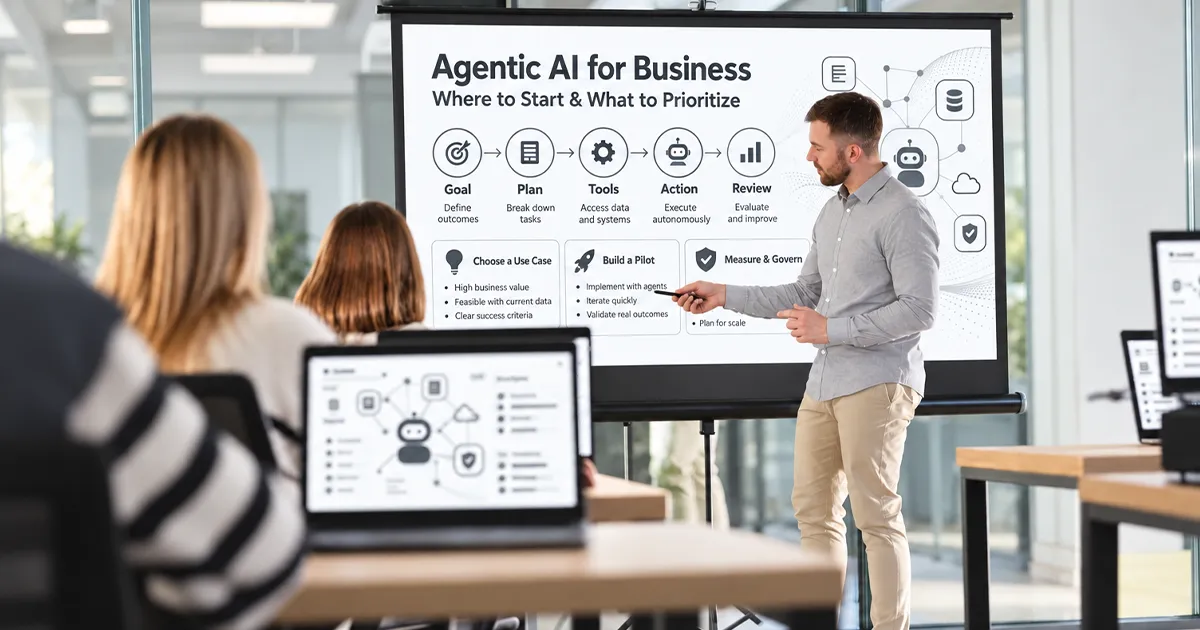
Agentic AI training for business is becoming an important workforce priority as enterprises move beyond AI assistants and basic automation. AI agents can reason through tasks, use tools, access information, and execute multi-step workflows with increasing autonomy.
However, enterprise adoption requires more than access to agentic AI platforms. Employees need to understand how agents work, where they can create business value, and when human oversight is required.
Therefore, organizations need a structured approach to capability development. The right training can help technical and business teams understand agentic workflows, responsible AI practices, governance, security, evaluation, and practical adoption.
What Is Agentic AI Training for Business?
Agentic AI training for business focuses on helping employees understand and apply AI agents within real enterprise workflows. Unlike traditional AI awareness programs, the learning scope extends beyond prompting and content generation.
AI agents can interpret goals, plan actions, use external tools, and execute tasks. This creates new opportunities across functions such as IT operations, customer service, software engineering, data management, finance, and business operations.
Consequently, enterprise training should address both technology and business execution.
A strong program can cover:
- Agentic AI fundamentals
- AI agent architecture
- Agentic workflows
- Prompting and context engineering
- Tool and API integration concepts
- AI agent evaluation
- Security and responsible AI
- Human oversight and governance
- Business use-case identification
- Workforce adoption and change
Why Agentic AI Training Matters for Enterprises
Agentic AI training for enterprises matters because autonomous systems can affect how work gets performed. An employee using an AI assistant may review the output before taking action. An agent can potentially perform several actions across connected systems.
That difference changes the workforce requirements.
Employees need to understand not only how to use agents, but also how to supervise them. They must know how to evaluate outputs, recognize exceptions, manage permissions, and escalate decisions when necessary.
Recent enterprise research also highlights the importance of workforce skills as AI becomes more autonomous. IBM’s 2026 CHRO study identifies supervising, validating, and overriding AI outputs as a critical workforce capability.
Where Should Enterprises Start With Agentic AI Training?
Agentic AI adoption enterprise programs should begin with business priorities rather than technology alone. Organizations should first identify where agents could support meaningful workflows.
Training can then be aligned with those use cases.
Start With AI and Agentic AI Literacy
The first priority should be a common understanding of agentic AI. Employees across business and technology teams should understand how agents differ from conventional automation and AI assistants.
Training should explain concepts such as:
- AI agents
- Agentic workflows
- Reasoning and planning
- Memory and context
- Tools and APIs
- Agent orchestration
- Human-in-the-loop controls
- Autonomous task execution
This foundation helps create a common vocabulary across leadership, IT, security, engineering, and business teams.
Prioritize Business Use Cases
Once employees understand the technology, training should connect agentic AI to business workflows.
For example, enterprises can explore opportunities in:
- IT service management
- Software testing and engineering
- Customer support
- Employee service operations
- Data analysis
- Finance operations
- Procurement workflows
- Sales operations
- Knowledge management
- Enterprise research
The goal is not to automate every process. Instead, teams should learn how to identify workflows where agentic capabilities can create measurable value.
Train Teams to Evaluate Agentic AI Use Cases
Use-case selection should consider business value, technical feasibility, data availability, risk, and the level of autonomy required.
Training can teach teams to ask practical questions:
- What business problem are we trying to address?
- Does the workflow contain repeatable tasks?
- What decisions must remain with employees?
- What enterprise systems would an agent need to access?
- What data would the agent require?
- What could happen if the agent makes an incorrect decision?
- How will business value be measured?
This approach helps organizations avoid treating agentic AI as a technology experiment without a defined business purpose.
What Should Agentic AI Training Cover?
A comprehensive enterprise program should build capabilities progressively. Employees should first understand the fundamentals. They can then move toward practical development, governance, testing, and enterprise adoption.
Agent Architecture and Orchestration
Technical teams need to understand how agents operate. This includes models, tools, memory, context, orchestration, data, and runtime environments.
Modern agent architectures typically combine several components rather than relying on a model alone. These components determine what an agent knows, what it can do, and how it performs multi-step tasks.
Training should therefore help technical employees understand the relationships between these components.
Prompting and Context Engineering
Traditional prompting remains useful, but agentic systems require broader context management. Employees need to understand how instructions, business context, tools, data, and memory influence agent behavior.
Training can cover:
- Task instructions
- Context design
- Structured outputs
- Tool selection
- Context retrieval
- Agent memory
- Multi-step task planning
This helps teams move from simple prompt usage toward more structured agent interaction.
Agent Testing and Evaluation
Testing becomes especially important when AI systems can take actions. Traditional software testing alone may not capture the variability of agent behavior.
Teams should learn how to evaluate accuracy, reliability, tool usage, safety, latency, cost, and task completion.
This is particularly relevant to the Agentic AI & Testing category because enterprises need repeatable evaluation practices before expanding agentic workflows.
Training should also introduce scenario-based testing. Teams can evaluate how agents behave under normal conditions, ambiguous instructions, incorrect information, system failures, and unexpected user requests.
Prioritize Governance and Responsible AI
Agentic AI adoption cannot scale safely without appropriate governance. As agents gain access to business systems and data, organizations need clear controls around identity, permissions, monitoring, and accountability.
IBM’s 2026 research highlights a growing control challenge as AI agents move into enterprise environments. The research notes that governance needs to keep pace with increasingly autonomous systems.
Train Employees on Human Oversight
Human oversight should be a core part of Agentic AI training for business. Employees need to understand when an agent can act independently and when human approval is necessary.
Training can cover:
- Approval workflows
- Escalation procedures
- Exception handling
- Output validation
- Decision boundaries
- Audit requirements
- Human override mechanisms
These capabilities become increasingly important when agents interact with financial, customer, employee, operational, or sensitive business information.
Build AI Governance Awareness
Governance should not remain limited to security and compliance teams. Business leaders, developers, data teams, and end users all need to understand their responsibilities.
Training can help establish common practices for responsible AI use. It can also help employees understand organizational policies before they begin working with autonomous systems.
This supports a more controlled approach to Agentic AI adoption enterprise initiatives.
Develop Role-Based Agentic AI Skills
Not every employee needs the same level of agentic AI expertise. Enterprise training should therefore be aligned with job responsibilities.
Business Leaders
Business leaders need enough knowledge to evaluate opportunities, risks, workforce impact, and business value.
Their training can focus on AI strategy, use-case prioritization, governance, operating models, and workforce readiness.
-
Technology and Engineering Teams
Technical teams require deeper capabilities. Their learning can cover agent architecture, orchestration, APIs, data integration, testing, security, observability, and deployment concepts.
For organizations developing broader AI capabilities, Cognixia’s Applied AI Training can support practical technical capability development.
-
Security and Risk Teams
Security teams need to understand the risks created when agents interact with enterprise systems. Training can cover identity, access, data security, monitoring, prompt injection risks, agent permissions, and incident response considerations.
Cognixia’s Cybersecurity Training can complement agentic AI capability development where security is a core enterprise priority.
-
Business and Operations Teams
Business teams should understand how to identify suitable workflows and work effectively with AI agents.
Their learning can focus on AI literacy, workflow redesign, agent supervision, output validation, and responsible adoption.
Connect Agentic AI Training With Enterprise AI Strategy
Agentic AI training for enterprises should not exist as an isolated learning initiative. It should connect with the organization’s broader AI readiness and enterprise technology strategy.
For example, an organization building an AI-enabled workforce may need learning pathways across AI literacy, data, cloud, cybersecurity, software engineering, and agentic AI.
Cognixia’s enterprise AI enablement focus can support this broader capability-building direction through enterprise learning and workforce development.
Organizations can also explore talent capability development when building emerging technology skills across their workforce.
Move From Awareness to Practical Capability
Awareness is only the starting point. Employees should have opportunities to apply what they learn to realistic enterprise scenarios.
A practical learning journey can progress through:
- AI and agentic AI awareness
- Business use-case identification
- Prompt and context skills
- Agent workflow design
- Testing and evaluation
- Security and governance
- Role-based practical application
- Continuous capability development
This progression allows enterprises to build skills without expecting every employee to become an AI engineer.
How to Build an Enterprise Agentic AI Training Program
Organizations can structure training around business priorities, employee roles, and technology maturity.
A practical enterprise program can include several layers:
| Training Layer | Primary Audience | Capability Focus |
|---|---|---|
| AI Awareness | Enterprise workforce | Agentic AI concepts and responsible use |
| Business Application | Business teams | Use cases, workflows, and adoption |
| Technical Skills | IT and engineering | Agents, tools, orchestration, data, and APIs |
| Testing and Security | Technical and security teams | Evaluation, monitoring, risk, and controls |
| Leadership | Business and technology leaders | Strategy, governance, workforce planning, and value |
Organizations can then connect these layers to specific roles and business functions.
Cognixia’s enterprise training programs can help organizations build structured technology learning pathways based on workforce requirements.
Measure the Impact of Agentic AI Training
Training should be measured beyond course completion. Enterprises need to understand whether employees can apply their new capabilities effectively.
Useful measures can include:
- AI literacy improvement
- Role-based skill assessment
- Successful use-case identification
- Agent workflow design capability
- Testing and evaluation proficiency
- Governance awareness
- Employee adoption
- Business process improvement
Organizations can also use capability assessments to identify where additional training is needed.
This creates a continuous learning cycle. As agentic technologies evolve, workforce programs can evolve with them.
Prepare Your Workforce for Agentic AI
Agentic AI is changing the relationship between employees and enterprise technology. AI agents can increasingly reason, plan, interact with tools, and execute multi-step workflows.
However, successful adoption depends on more than technology. Enterprises need employees who understand the opportunities, limitations, risks, and responsibilities associated with autonomous AI systems.
That makes workforce development a central part of an enterprise AI strategy. Organizations that combine technical capability with business understanding, testing, governance, and human oversight can build a stronger foundation for responsible adoption.
Explore Cognixia’s training categories to identify learning areas that can complement your enterprise agentic AI capability strategy.
You can also explore Cognixia Insights for perspectives on emerging technologies, enterprise learning, and workforce capability development.
Build Agentic AI Capabilities With Enterprise Training
Learn from experts, explore industry trends, and upskill for the future.
Talk to Experts
Ready to prepare your workforce for agentic AI? Cognixia helps enterprises develop AI-ready capabilities through structured corporate training, role-based upskilling, and practical technology learning programs.
From AI fundamentals and applied AI to agentic workflows, testing, cybersecurity, and enterprise AI enablement, training can be aligned with the roles and capabilities your organization needs next.