
Quick Answer
To upskill employees in generative AI, run a 90-day, role-based programme. Spend the first 30 days on AI literacy and safe-use rules, the next 30 on practice with real work tasks, and the last 30 on embedding habits and measuring results. Start with a skills baseline so each group learns what its job needs.
Key Takeaways
- Literacy first, tools second, habits last.
- Role-based paths beat one course for everyone.
- Measure changed behaviour, not course completions.
How Do You Upskill Employees in Generative AI in 90 Days?
Split it into three 30-day phases: build literacy and guardrails, practise on real tasks, then embed and measure. Flip that order and people use the tools before they understand the risks.
- Days 1 to 10: baseline. Survey current AI use and confidence by role. Note who’s experimenting and who’s avoiding it.
- Days 11 to 30: literacy and guardrails. Teach what generative AI can and can’t do, plus your data rules. Short sessions, plain language.
- Days 31 to 45: role-based pathways. Give each group practice tasks pulled from its own job.
- Days 46 to 60: champions. Name one confident colleague per team and run weekly practice clinics.
- Days 61 to 80: real workflows. Each person redesigns one recurring task with AI and writes down how.
- Days 81 to 90: measure and decide. Compare against the baseline, keep what worked, plan the next cohort.
Each phase ends with a gate. Don’t start phase two until the safe-use policy is signed off and baseline numbers exist.
The 30-60-90 day plan.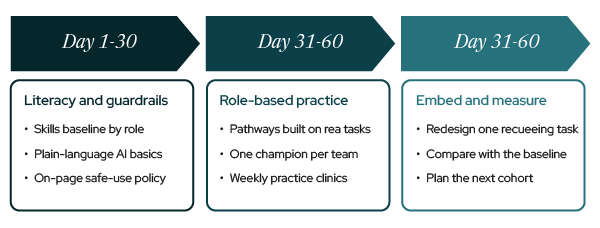
Why bother with a deadline? The World Economic Forum’s Future of Jobs Report 2025 found that employers expect 39% of workers’ skills to change by 2030, and 63% name skill gaps as the biggest barrier to transformation. Ninety days is long enough to change habits and short enough to keep attention.
What AI Skills Do Non-Technical Employees Need?
Five, and none involve code: a basic grasp of how generative AI works, clear prompting, checking outputs for errors, handling data safely, and knowing when not to use it.
| Role | Learn | Prove it | Cognixia area |
|---|---|---|---|
| Business and operations | Prompting, output checking, task redesign | One weekly task rebuilt with AI | Productivity |
| HR and L&D | Policy, bias, coaching others | Draft of the safe-use guide | Enterprise AI enablement |
| Managers | Setting expectations, spotting risky use | Team use-case list | Enterprise AI enablement |
| Developers | Integration, evaluation, security | Working internal prototype | Applied AI |
| Data teams | Retrieval, data quality, governance | Tested data pipeline for AI | Data AI |
One course for everyone won’t work. McKinsey’s Superagency report found employees are three times more likely to be using generative AI than their leaders expect, yet 41% are apprehensive and need extra support. Your enthusiasts and your sceptics need different starting points.
How Do You Build AI Literacy in an Enterprise?
Start with short, plain-language sessions on what generative AI is, where it fails and which data is off limits. Then reinforce through daily work, not lectures.
Three habits do most of the work. First, teach the failure modes early. Once people have watched a confident answer turn out wrong, they check. Second, publish a one-page policy people will actually read. Third, give them a safe place to practise, so nobody pastes customer data into a public tool to “just try it.”
Managers matter more than slides. If a team lead never mentions AI in one-to-ones, the team assumes it’s optional. And don’t dodge the job-security question. Say plainly what’s changing and what isn’t. This joined-up approach is the heart of Enterprise AI enablement: literacy, role-based paths and governance moving together. Once literacy is solid, our guide to agentic AI training for business covers the next step.
Cognixia’s Source-Build-Embed View of AI Upskilling
We use Source-Build-Embed to judge programme readiness. Source is finding the tasks worth changing. Build is developing skills through practice. Embed is making the new habit survive after the training ends. Our view: most programmes pour effort into Build and run out of steam before Embed.
A quick self-check:
- Source: Can each team name five recurring tasks where AI could save time, ranked by effort?
- Build: Does every learner practise on their own work, not a generic demo?
- Embed: Six weeks on, would people still use it without a reminder, and do managers ask about it?
For example, a finance team might pick invoice-query replies, practise on anonymised cases and time the drafting before and after. Be strict. A completed course isn’t a changed habit, and a demo that wowed the room isn’t adoption. Two honest “no” answers? Good, now you know where to focus. Our Source-Build-Embed page explains how we train for all three.
What Mistakes Stall Enterprise AI Training?
Four show up again and again.
- Licences before literacy. Tools handed out with no guidance get tried once and dropped.
- One course for everyone. Finance and engineering need different practice.
- No manager involvement. Without sponsors, nothing sticks.
- Counting completions. Track weekly active use and time saved on one task, against your Day 1 baseline.
Fixing these doesn’t need a bigger budget. It needs a sequence. Baseline on Day 1, practise on real tasks, and review against the baseline on Day 90. Keep whatever moved the numbers, and change the rest before the next cohort starts.
Frequently Asked Questions
Load More
Conclusion: Your Next Move
- Baseline first, then run the three 30-day phases in order.
- Build each role’s path on its own tasks, not a generic deck.
- Measure habits, not course completions.
Build an AI-Ready Workforce
Knowing how to upskill employees in generative AI is the easy half. Getting thousands of people to change how they work is where programmes stall. Start with the self-check above, then talk to Cognixia about Enterprise AI Enablement, and we'll shape a 90-day plan around your roles and tools. Ninety days from now, you could have habits instead of shelfware.
Talk to Cognixia