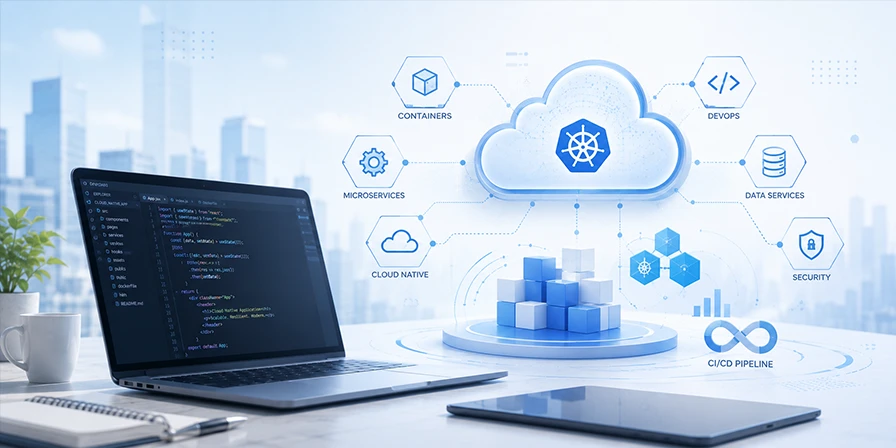
Modern enterprises are under constant pressure to deliver applications faster, scale services reliably, and support digital experiences across global users, channels, and workloads. At the same time, traditional application architectures often struggle to keep pace with changing business requirements, release expectations, and infrastructure complexity. As a result, Cloud Native Development is becoming a strategic priority for organizations building scalable, resilient, and continuously evolving applications.
However, cloud-native transformation is not only about adopting Kubernetes, containers, or new deployment models. It also requires enterprise teams with the right development, DevOps, and architecture skills. Therefore, organizations are investing in enterprise training, workforce upskilling, and role-based learning to help engineering teams build Cloud Native applications that support performance, agility, and long-term business growth.
Why Cloud Native Development Matters for Scalable Enterprise Applications
Cloud Native Development enables organizations to build and run applications in ways that are more resilient, manageable, and scalable than traditional monolithic approaches. Instead of tightly coupled systems that are difficult to update and scale, cloud-native architectures use Microservices, containers, automation, and orchestration to support faster releases and better operational flexibility.
According to the Cloud Native Computing Foundation, cloud native applications are designed to take advantage of cloud environments through scalability, resiliency, observability, and automation. Therefore, enterprises that want to modernize application delivery need teams who understand not only the underlying tools, but also the architectural and operational practices required to build scalable cloud-native systems.
- Improve application scalability across dynamic workloads
- Support faster software releases and updates
- Increase resilience through loosely coupled services
- Improve observability and operational visibility
- Enable better resource utilization across cloud environments
- Reduce deployment bottlenecks through automation
- Create a stronger foundation for continuous innovation
Core Cloud Native Development Skills Enterprise Teams Need
Cloud Native Development depends on a combination of application design, infrastructure awareness, automation knowledge, and platform engineering skills. Teams must understand how Microservices, containers, APIs, and cloud services work together to support scalable application delivery. In addition, they need to design systems that can handle failure, adapt to demand, and evolve without disrupting the full application stack.
CNCF notes that cloud native technologies enable loosely coupled systems that are resilient, manageable, and observable, while supporting frequent, predictable changes through robust automation. That means enterprise teams need practical skills across architecture, deployment, observability, and DevOps workflows rather than focusing only on a single tool such as Kubernetes or Docker.
- Microservices architecture design and decomposition
- Containerization fundamentals using Docker and related tooling
- Kubernetes orchestration and workload deployment basics
- API-first development and service communication patterns
- Application observability and monitoring awareness
- Resilience, fault tolerance, and scalability planning
- Infrastructure as Code and environment automation
- CI CD workflow integration for cloud-native delivery
- Security awareness for distributed application environments
Microservices, Containers, and Kubernetes Skills for Application Scalability
Scalable Cloud Native applications are typically built around modular services that can be deployed, updated, and scaled independently. That is why Microservices, containers, and Kubernetes remain foundational capabilities for enterprise development teams. These technologies allow organizations to separate application components, improve deployment flexibility, and manage workloads more efficiently across cloud environments.
At the same time, these technologies introduce new design and operational considerations. Teams must understand service boundaries, inter-service communication, state management, container packaging, and orchestration principles. Strong skills in these areas help enterprises avoid unnecessary complexity while building applications that scale more effectively.
Cognixia’s Operations Engineering Training programs and Enterprise Upskilling Programs help organizations build practical cloud-native and DevOps capabilities across engineering teams.
- Breaking monolithic applications into service-based components
- Container build, packaging, and deployment workflows
- Kubernetes resource and workload management fundamentals
- Service discovery and communication awareness
- Scaling strategies for stateless and stateful workloads
- Deployment consistency across development and production environments
- Operational troubleshooting in containerized environments
Serverless, DevOps, and Automation Skills for Faster Cloud Native Delivery
Cloud Native Development also depends on how efficiently teams can automate delivery and reduce manual operational work. DevOps practices, CI CD workflows, and serverless deployment models all play a role in accelerating release cycles and improving development efficiency. Therefore, enterprises need employees who can combine software engineering practices with automation and platform awareness.
In many cases, serverless services complement containerized applications by supporting event-driven workloads, APIs, and lightweight business functions without requiring teams to manage underlying infrastructure. Meanwhile, strong DevOps practices help teams build reliable pipelines, standardize deployments, and improve collaboration between development and operations functions. Together, these skills support faster and more scalable application delivery.
Cognixia supports cloud-native workforce development through DevOps and Operations Engineering Training aligned to automation, CI CD, cloud delivery, and enterprise application modernization goals.
- CI CD pipeline design and release automation awareness
- Infrastructure as Code fundamentals for repeatable environments
- Serverless architecture understanding for event-driven use cases
- Environment provisioning and deployment standardization
- Automation-first thinking for cloud operations
- Collaboration practices across development, QA, and operations teams
- Observability integration into deployment workflows
- Continuous improvement of delivery pipelines and release practices
Building a Future Ready Workforce for Cloud Native Application Development
Cloud Native adoption is as much a people transformation initiative as it is a technology strategy. Enterprises need development teams that understand modern architecture patterns, automation practices, and scalable application design. Therefore, Cloud Native Development skills should be part of broader workforce transformation and enterprise learning strategies.
Furthermore, organizations that invest in structured training can improve development consistency, reduce migration risk, and accelerate application modernization efforts. By building Cloud Native, DevOps, and Microservices capabilities across engineering teams, enterprises can strengthen delivery performance while preparing for future platform and application demands.
Cognixia’s enterprise training programs help organizations build Cloud Native Development, Kubernetes, DevOps, and scalable application delivery capabilities through corporate training, workforce upskilling, and role-based digital learning programs.
- Enterprise training for cloud-native application development teams
- Role-based upskilling in Microservices, Kubernetes, and DevOps
- Cloud-native delivery readiness for engineering organizations
- Application modernization support through workforce development
- Training aligned to scalability, automation, and resilience goals
- Cross-functional capability building for developers and platform teams
- Future ready workforce development for modern cloud applications
Ready to Upskill Your Cloud Native Teams?
Cognixia helps enterprises build Cloud Native, Microservices, Kubernetes, and DevOps capabilities through corporate training and workforce upskilling programs.

Conclusion
Cloud Native Development is now central to how enterprises build scalable applications, accelerate software delivery, and modernize digital platforms. Yet successful cloud-native adoption depends on more than infrastructure choices or tool selection. Organizations need teams with the skills to design Microservices, manage containers, automate delivery, and operate applications across dynamic cloud environments. By investing in enterprise training and workforce upskilling, businesses can build the Cloud Native capabilities needed to improve agility, resilience, and long-term application performance.