Quick Answer
Spec-driven development (SDD) is a way of building software where a clear, structured specification, not a chat prompt, drives the work. Teams write what the feature must do, plan the approach, break it into small tasks, then let AI coding assistants implement each task while humans review the results against the spec.
Key Takeaways
- The spec, not the prompt, becomes the source of truth.
- Five steps: specify, clarify, plan, break down, implement.
- It adds up-front effort, so use it where rework is costly.
What Is Spec-Driven Development?
Spec-driven development is a workflow where a written specification guides what gets built, and AI agents generate code from it. The spec describes behaviour and intent. The code follows.
Why now? AI assistants write code fast, but vague prompts produce confident guesses. GitHub’s team describes the shift as moving from code as the source of truth to intent as the source of truth. The spec becomes a living, versioned artifact that people and agents share.
Be honest about maturity, though. Thoughtworks put the technique in the Assess ring of its Technology Radar in November 2025 and noted that the definition is still evolving. Worth trying, not worth betting the programme on.
Think of it as three layers. The spec says what and why, the plan says how, and the tasks say what to build next. Each layer is small enough for a person to read in minutes, and each gives the assistant tighter guardrails than any chat message could.
How Does Spec-Driven Development Work with AI Coding Assistants?
You write the spec first, and the assistant works from it task by task. Humans stay in the loop at every checkpoint.
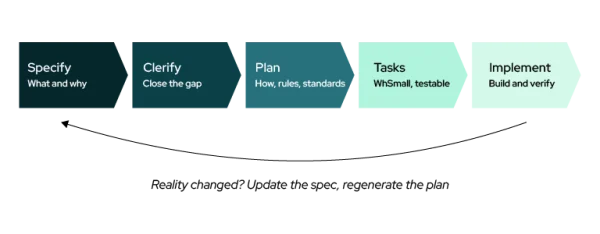
- Write the spec. Describe what the feature must do and why, in plain language. Leave out the how.
- Clarify and review. Close gaps and ambiguity with the team before any code exists.
- Plan the approach. Record architecture, constraints, security rules and coding standards.
- Break it into tasks. Make each task small enough to build and test on its own.
- Implement and verify. The assistant builds one task at a time. You check results against the spec’s acceptance criteria and update the spec when reality changes.
The five-step spec-driven development workflow.
Here’s how small a useful spec can be:
Feature: Export order history (CSV)

Why: Support teams need offline reports.

Rules:

- Only users with the Support Lead role can export.

- Exports cover the last 12 months, max 50,000 rows.

- Every export is written to the audit log.

Acceptance criteria:

- A user without the role gets a 403 response.

- A 60,000-row request returns a clear error, not a partial file.

- The audit entry holds user ID, date range and row count.
Notice what’s missing: no framework, no file names. Those belong in the plan, which the assistant drafts and your engineers approve.
What Spec-Driven Development Tools Are Available?
Three names come up most: GitHub Spec Kit, Amazon Kiro and Tessl. Each interprets the idea differently.
| Tool | Approach | Worth knowing |
| GitHub Spec Kit | Open-source toolkit: specify, plan, tasks, implement | Adds a “constitution” of principles agents must follow |
| Amazon Kiro | Guided stages: requirements, design, tasks | Workflow built into the tool |
| Tessl Framework | The spec itself is the maintained artifact | In private beta as of September 2025 |
Thoughtworks notes these tools behave very differently by task size, and some generate long spec files that are hard to review. GitHub says Spec Kit works with Copilot, Claude Code and Gemini CLI. Pick one, pilot it on a single feature, and judge it by review time, not novelty. Whichever you choose, the habits transfer, because all three rest on the same idea: write intent down first.
Cognixia’s Source-Build-Embed View of Spec-Driven Development
We use Source-Build-Embed to judge readiness for any new way of working. Source is choosing the right first feature and spec owner. Build is writing specs and running the workflow. Embed is making specs part of review, version control and daily habits. Our view: teams grab a tool before agreeing what a good spec looks like.
A quick self-check:
- Source: Have you picked one well-understood feature, with a named spec owner, as your pilot?
- Build: Can your engineers write testable acceptance criteria and critique an AI-generated plan?
- Embed: Are specs reviewed in pull requests and stored beside the code?
Be strict. A spec nobody reads is shelfware. Two honest “no” answers? Fix those first. Our Source-Build-Embed page explains how we train for all three.
What Are the Best Practices for Spec-Driven Development in Enterprise Teams?
Keep specs short, testable and versioned with the code, and keep a human approving each checkpoint.
- Separate what from how. Specs hold intent; plans hold technology choices.
- Write criteria you can test. If it can’t fail, it isn’t a requirement. Our Quality Engineering AI area covers this skill.
- Keep standards in one place. Security, compliance and coding rules live in a shared principles file every agent reads.
- Review specs like code. Pull requests, owners and change history.
- Right-size it. Skip it for one-line fixes and throwaway prototypes.
Oversight matters just as much with agents in the loop, which our guide to agentic AI training for business covers in depth. Engineers building these skills can start with Cognixia’s Applied AI training.
Frequently Asked Questions
Load More
Conclusion: Your Next Move
- Learn the five steps: specify, clarify, plan, break down, implement, and why each exists.
- Pilot on one well-understood feature with a named spec owner.
- Review specs like code, and keep humans at every checkpoint.
Interested in Spec-Driven Development Training?
Learn from experts, explore industry trends, and upskill for the future.
Talk to Cognixia